Published: September 5, 2025 | Published By: Real Creative Agency
VERSES Genius Active Inference Menu
- What is Genius Active Inference
- Genius with Active Inference is next generation AI
- How Genius is different than LLMs and ML
- How Genius helps solve problems for LLMs and ML
- How Genius can be used with large language models
- How Genius can be used with machine learning
- How Genius works with both LLM and ML
- How Genius provides reasoning with static and dynamic data
- Genius Active Inference (Darwin)
- Things Genius CANNOT do
- How Genius can make LLMs and ML better
- How companies can use Genius and Active Inference
- Possible Industry uses for Genius and Active Inference
What Is Genius Active Inference
VERSES Genius, is a Bayesian inference reasoning engine powered by Active Inference, a neuroscience-inspired approach pioneered by world renowned neuroscientist Karl Friston and VERSES’ Chief Scientist.
At its core is the Free Energy Principle, that says that intelligent systems, whether brains or machines, survive and thrive by minimizing uncertainty about the world.
That means Genius doesn’t just analyze static datasets the way ML or LLMs. It reasons, plans, and adapts dynamically, making it better suited for environments where conditions are always changing.
With Genius you can build and query probabilistic models using your OWN domain knowledge or learn from a dataset. With active inference you can build a model that can take perform decision-making to choose the optimal course of action.
Genius with Active Inference is Next Generation AI
Companies don’t just need prediction, they need prediction + reasoning + action in both stable and fast-changing environments.
Genius is the first AI solution built to unify static and dynamic intelligence into ONE adaptive, causal, and decision-making framework.
Genius combines THREE kinds of intelligence into ONE platform.
It predicts:
- What’s likely to happen
- It decides the best next action in real time
- Explains the cause-and-effect behind outcomes.
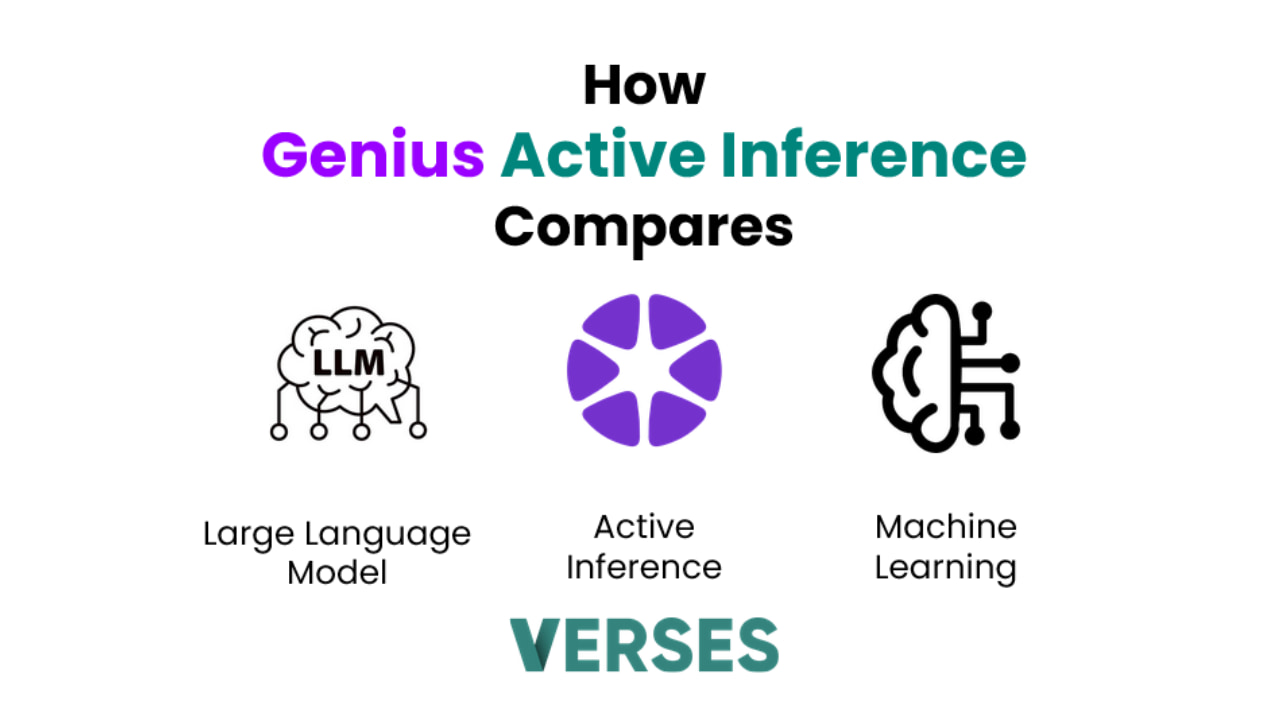
Machine Learning (ML): Excellent at finding patterns in static data (historical records, past transactions, stored images). But once conditions change, ML struggles to adapt because it isn’t designed for real-time reasoning.
Large Language Models (LLMs): Strong at generating text and content from static training data, but they don’t truly understand cause-and-effect or how actions unfold in dynamic environments.
Genius from VERSES: Combines the strengths of both worlds. It can use static data for deep historical insights and dynamic data (real-time streams like sensors, IoT devices, market shifts, or human input) to update its understanding on the fly.
Built on active inference, Genius doesn’t just recognize patterns, it can predict outcomes, reason through cause-and-effect, and plan adaptive actions in real time.
Genius fills the gap LLMs and ML can’t reach, turning AI into a reasoning engine for the real world.
LLM = works well with language and static text.
ML = finds patterns in historical structured data.
Genius = uses reasoning, planning, prediction, and adaptation with both static and dynamic data, so it can act in real time.
Genius: Combines prediction, decision-making, and causal reasoning into a single framework. It doesn’t just say what’s likely to happen, it understands why, grounded in a world model, and then decides what to do next
How Genius is Different from LLMs and ML
Dynamic, real-time reasoning – Genius can adapt its decisions as environments change, not just rely on static training data.
Causal understanding – Instead of correlations, Genius can model cause and effect, critical for planning and prediction.
Continuous learning without retraining – Genius learns as it goes, while ML/LLMs need retraining on large new datasets.
Predicting outcomes in open systems – Genius works in environments with moving parts and uncertainty, not just closed datasets.
Goal-driven decision making – Genius can plan actions toward specific goals, LLMs only output likely text or patterns.
Energy-efficient intelligence – Genius requires far less compute than massive LLM models that need huge GPUs and servers.
Data-sparse reasoning – Genius can work with little or no data, unlike ML/LLM which need mountains of examples.
Interoperability with real-world devices – Genius agents can sense and act in real environments, not just text outputs
Adapting to novel situations – Genius can improvise in environments it hasn’t seen before. LLMs hallucinate when outside training data.
Understanding context across time – Genius remembers past states and future goals, while LLMs focus on next-token prediction.
Safety in decision loops – Genius aligns decisions with constraints and rules in real-time, preventing unintended actions.
Self-updating world models – Genius updates its model of the environment as things change. ML models freeze once trained.
Multi-agent coordination – Genius agents can work together in shared environments. LLMs can’t coordinate actions.
Handling uncertainty – Genius reasons with probabilities and incomplete information. LLMs guess based on prior text.
Physical world integration – Genius can control robots, drones, vehicles, or smart infrastructure with adaptive intelligence.
Regulatory compliance in real time – Genius can align agent behavior with changing rules/laws dynamically. LLMs can only describe them.
Simulating complex environments – Genius models “what if” scenarios for logistics, cities, finance, etc., beyond statistical prediction.
Cross-domain reasoning – Genius can combine inputs from text, sensors, maps, time-series data seamlessly.
Planning with constraints – Genius can plan actions within budget, time, or ethical constraints. LLMs don’t plan.
Active inference at scale – Genius doesn’t just analyze data, it acts, tests, updates, and re-acts in cycles, creating feedback loops that ML/LLMs can’t.
How Genius Helps Solve Problems for LLMs and ML
- Adapts to real-world change in real time.
- Understands cause and effect, not just patterns.
- Learns continuously without retraining.
- Predicts outcomes in unpredictable environments.
- Plans and acts toward specific goals.
- Runs efficiently without massive compute costs.
- Works with limited or sparse data.
- Connects directly with sensors, devices, and machines.
- Improvises when facing new situations.
- Keeps context across past, present, and future.
- Aligns decisions with safety and compliance in real time.
- Updates its world model as conditions change.
- Coordinates multiple agents working together.
- Handles uncertainty and incomplete information.
- Integrates intelligence into robotics. workflows and infrastructure.
- Stays compliant as rules and laws evolve.
- Simulates “what-if” scenarios across industries.
- Combines text, sensor, and time-series data seamlessly.
- Plans within real-world constraints like cost or time.
- Creates feedback loops that improve decisions continuously.
How Genius Can Be Used with Large Language Models LLMs
LLMs excel at generating knowledge, answering questions, and surfacing insights from text, but they can’t plan or act in the real world.
Genius can use those LLM outputs as knowledge inputs, then reason, plan and act on them.
For instance, an LLM can summarize regulations, and Genius can ensure an autonomous system actually complies with those rules in real time.
LLMS explain, Genius executes.
How Genius Can Be Used with Machine Learning ML
Machine learning is great at spotting patterns in massive datasets, but it stops at static predictions.
Genius takes those predictions and turns them into real-time decisions and actions.
For example, ML can forecast demand for a product, and Genius can dynamically adjust supply chains, routes, and pricing to match that demand as conditions shift.
Together, ML provides insights, and Genius provides adaptive intelligence.
How Genius Can Be Used With LLM and ML
Breakthroughs can come when established or existing technologies are combined with Genius.
ML crunches data to find patterns, LLMs translate that data into human-readable insights, and Genius connects it all to the physical world by adapting decisions as conditions change.
Think: ML forecasts customer demand, an LLM generates marketing and customer-facing explanations, and Genius automatically adjusts inventory, logistics, and promotions in real time.
Together they create a closed loop of prediction, understanding, and action.
LLM (Large Language Models)
- Strength: Understand and generate language
- Weakness: Static, lacks real-time reasoning
- Role: Acts as the interface (memory + conversation)
ML (Machine Learning)
- Strength: Finds patterns and predicts outcomes
- Weakness: Overfits static data, limited adaptability
- Role: Pattern recognition + prediction engine
Genius
- Strength: Cause-effect reasoning, decision-making, planning
- Weakness: Needs LLMs/ML for raw knowledge & pattern detection
- Role: Orchestrator that makes LLM + ML useful in the real world
LLM + ML → Genius = Complete AI Brain
How Genius Provides Reasoning with Static and Dynamic Data
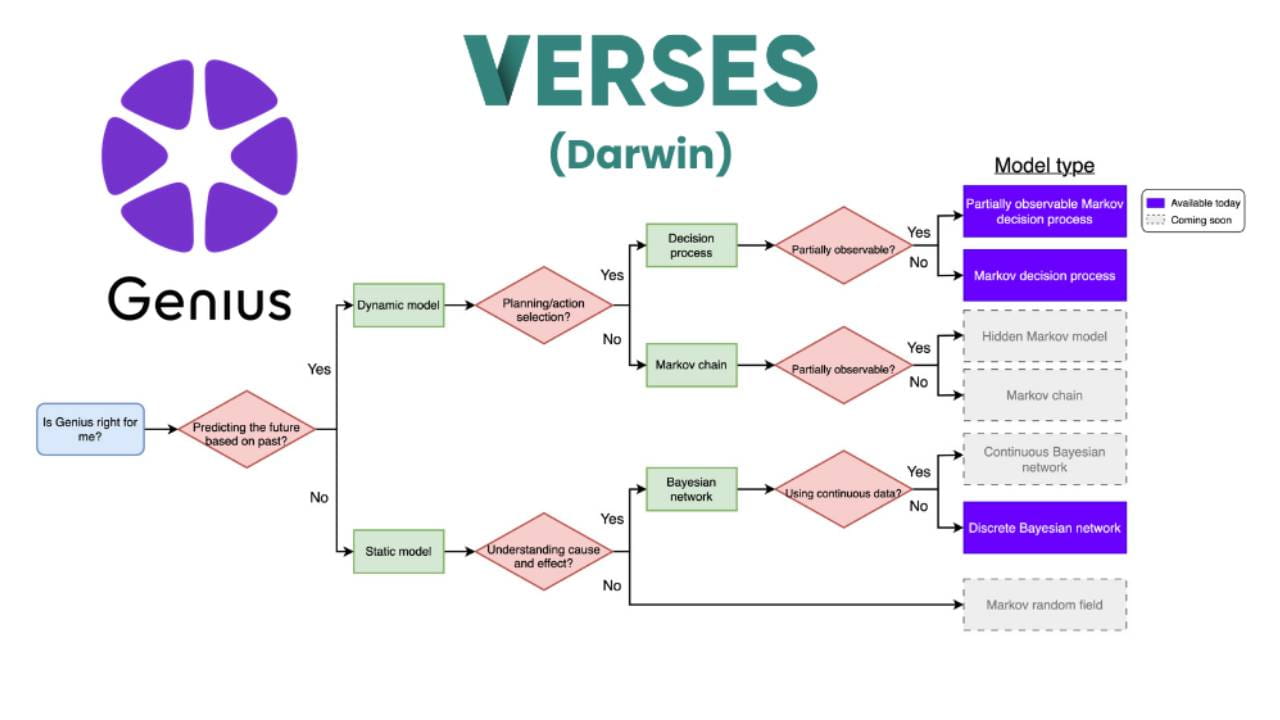
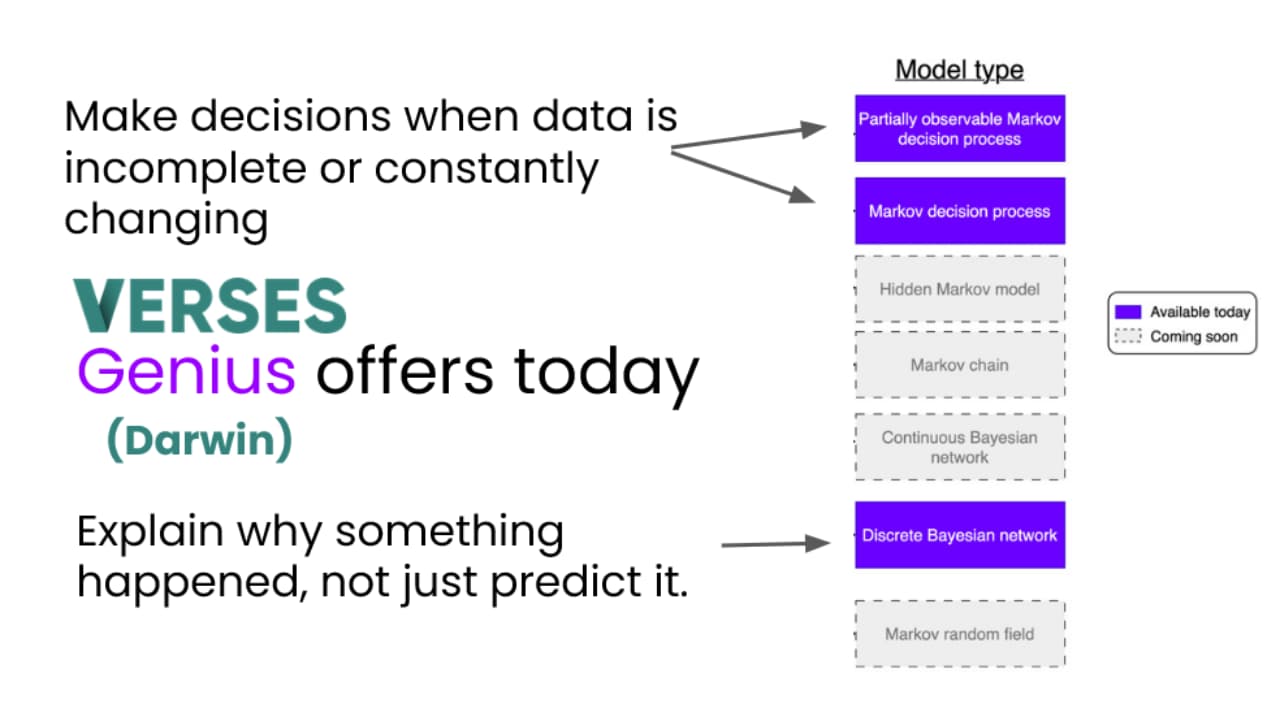
When businesses need to make decisions when data is incomplete or constantly changing.
Genius solves this with Markov Decision Processes and Partially Observable Decision Processes
When businesses need to explain why something happened, not just predict it.
Genius solves this with Discrete Bayesian Networks
Companies need more than simple predictions from AI; they require solutions that provide reasoning and actionable steps based on both static and dynamic data.
Static data represents the historical, unchanging information, the ‘what happened in the past.’
Dynamic data, on the other hand, is the real-time, constantly changing information.
Most existing AI models, such as large language models (LLMs) and traditional machine learning, struggle to effectively combine these two types of data.
Genius is the first AI solution built to unify static and dynamic intelligence into ONE adaptive, causal, and decision-making framework.
VERSES Genius Active Inference (Darwin)
Things Genius CANNOT Do
- Genius isn’t ChatGPT – it doesn’t generate text, it makes decisions.
- Genius isn’t Machine Learning – it doesn’t just spot patterns, it adapts to change.
- Genius isn’t a Data Lake – it doesn’t need endless historical data to work.
- Genius isn’t a Black Box – it’s explainable and transparent in its reasoning.
- Genius isn’t Static AI – it learns and updates in real time.
- Genius isn’t a Replacement for Humans – it’s an augmentation tool, not an autonomous overlord.
- Genius isn’t Confined to One Task – it can operate across domains through interoperable agents.
- Genius isn’t Reactive Only – it predicts, plans, and acts proactively.
- Genius isn’t a Cost Sink – it’s lightweight and energy-efficient compared to LLMs.
- Genius may be the Future of AI – it’s the bridge that makes the future possible today.
How Genius Can Make LLMs and ML Better
Genius is a COMPLEMENT to LLM and ML
Genius isn’t trying to BE an LLM or ML model.
Instead, it solves the cause-and-effect reaoning gap that LLMs and ML struggle with.
Think of Genius as the BRAIN (“digital brain“) that makes use of the memory (LLMs) and the intuition (ML).
Genius makes LLMs and ML better
With LLMs: Genius provides reasoning and decision-making so LLMs aren’t just parroting language but actually helping execute tasks reliably.
With ML: Genius helps avoid overfitting to static data and enables real-time adaptability by combining dynamic inputs and causual reasoning.
LLMs = memory + conversation
ML = pattern recognition + prediction
Genius = reasoning + planning + action
Together, they form the complete brain of AI.
LLMs = language & knowledge
ML = patterns & predictions
Genius = cause-effect reasoning + decision-making
Genius is the “brain” that makes LLM + ML actually useful for mission-critical industries
How Companies Can Use Genius and Active Inference
Customer Support Data
- LLM: A company can use an LLM to train a chatbot on past customer emails, chats, and FAQs so it can answer questions in natural language.
- ML: Machine learning models can analyze patterns in customer complaints to predict churn risk or common product issues.
- Genius: Genius can model the cause-and-effect relationships in customer interactions, so it not only answers questions but can plan next steps, like escalating a ticket or suggesting a proactive fix before a complaint happens.
Sales & Marketing Data
- LLM: Summarize CRM notes or generate personalized outreach emails at scale.
- ML: Score leads based on historical sales conversions to prioritize follow-ups.
- Genius: Go beyond scoring by simulating how a change in budget, messaging, or channel will impact conversions over time, giving the sales team a decision-making edge.
Operations & Supply Chain Data
- LLM: Parse logistics documents, invoices, and contracts to quickly answer questions like “When does shipment 2457 arrive?”
- ML: Forecast demand for products using historical sales and seasonal data.
- Genius: Dynamically adjust inventory levels and reroute shipments in real time when unexpected events (port delays, weather, supplier shortage) happen, since it can reason with dynamic data.
Healthcare Data
- LLM: Help doctors by summarizing patient notes or medical research.
- ML: Predict patient outcomes or risk scores based on historical patient data.
- Genius: Create adaptive treatment plans that update in real time as new test results, vitals, or symptoms are added, offering a step toward precision medicine.
Finance & Risk Data
- LLM: Summarize long reports, filings, or contracts for analysts.
- ML: Detect fraud patterns in transaction data.
- Genius: Run what-if simulations to test how market moves, regulatory changes, or new product launches ripple through the business, helping leaders plan with foresight.
Possible Industry Uses For Genius and Active Inference
Online Advertising
LLM
- Good at: Writing ad copy, answering customer queries.
- Lacks: Understanding why people buy, predicting long-term campaign effects.
ML
- Good at: Audience segmentation, click-through prediction.
- Lacks: Adapting to sudden changes (ex. new trend, regulation).
Genius
- Adds: Cause-effect reasoning, can understand why an ad performs well and adjust strategy in real time.
- Example: Predicting not just clicks, but lifetime customer value.
Cybersecurity
LLM
- Good at: Explaining threats in plain language.
- Lacks: Real-time defense, causal understanding of attacks.
ML
- Good at: Detecting patterns in network traffic.
- Lacks: Struggles with novel threats or attacks that don’t look like past data.
Genius
- Adds: Predictive modeling of attacks + causal reasoning to anticipate hacker strategies.
- Example: Blocking zero-day exploits before they’re executed.
Robotics
LLM
- Good at: Conversational interface with robots (e.g., telling a robot what you want it to do).
- Lacks: Physical reasoning, real-world adaptability.
ML
- Good at: Image recognition, object detection.
- Lacks: Planning across complex tasks (fetching a box in a warehouse).
Genius
- Adds: End-to-end decision-making + adaptive planning.
- Example: A warehouse robot that plans a full route, adapts if aisles are blocked, and explains why it chose that path.
Finance
LLM
- Good at: Summarizing earnings reports, customer support chat.
- Lacks: Predictive accuracy for markets, causal drivers of risk.
ML
- Good at: Stock prediction based on historical data.
- Lacks: Breaks during black swan events (COVID, 2008 crisis).
Genius
- Adds: Causal forecasting + reasoning under uncertainty.
- Example: Stress testing portfolios under future scenarios like new regulations or interest rate hikes.
Smart City
LLM
- Good at: Providing information to citizens.
- Lacks: City-wide optimization.
ML
- Good at: Predicting traffic or energy demand.
- Lacks: Holistic coordination across systems.
Genius
- Adds: Integrated decision-making across transportation, energy, policing.
- Example: Rerouting traffic in real time while balancing pollution and public safety
Disclaimer
This information is for educational purposes only, it is NOT investment advice. It is published as an information service for highly speculative investors, and it includes opinions on buying, selling, and holding various stocks and other securities. VERSES AI Inc is an extremely high-risk investment, and it is HIGHLY LIKELY you can LOSE YOUR ENTIRE INVESTMENT. Investors should consult with their financial advisor BEFORE making ANY investment.
Prospective investors should carefully consider and evaluate all risks and uncertainties involved in an investment in this Company, including risks related to the Company’s limited operating history, the Company’s need for additional funding, the Company’s ability to successfully implement its growth strategy, conflicts of interest, the uncertainty of the use of available funds, the Company’s failure to manage growth, and reliance on strategic partnerships.
The information provided is obtained from sources believed to be reliable but is not guaranteed for accuracy or completeness. Any persons who buy, sell, or hold securities should do so with caution and consult with a broker or investment adviser before doing so.
Any discussions and pages may contain forward-looking statements that involve risks and uncertainties. A company’s results could differ materially from those in forward-looking statements or announcements.
All material is for informational purposes only and should not be construed as an offer or solicitation of an offer to buy or sell securities.
At various times, we may own, buy or sell the securities discussed for investment or trading purposes. We (publishers, owners, and agents) are not liable for any losses or damages, monetary or otherwise, that result from the content shared.
Artificial Intelligence Stock Reading
- The Best Artificial Intelligence Penny Stock VERSES AI
- Artificial Intelligence Stock with BIGGEST Potential
- What is BETTER than ChatGPT Generative Artificial Intelligence
- Generative Artificial Intelligence Regulation Solution
- How To Govern and Regulate Artificial Intelligence
- The BEST C3 AI Stock Alternative
- Next Generation Intelligence Patent Application
- The ONLY Adaptive Artificial Intelligence Stock
- Artificial Intelligence Stocks
- VERSES VRSSF 2023 Year End Summary
- The Story of VERSES AI VRSSF
- How VERSES AI Solves the Generative AI Problem
GET On Google's First Page
I want to be found in Google searches today!
1 POST ONLY $99
Bottom Line
Our nanocap marketing agency believes that creative content is better than spending money on ads.
Daily helping our most valuable asset “YOU” since 2005.
Real Creative Agency

Digital Marketing Experts
Daily helping our most valuable asset "YOU" since 2005.