
Published: August 29, 2026 | Published By: Real Creative Agency
American EcoFuels™ Could (OTC: AEFI) Be Engineering Fuel 2.0?
For more than a century, humanity engineered better machines.
American EcoFuels™ believes it may be time to engineer what powers them.
Human civilization changed when we learned to control fire.
Wood gave way to coal. Coal powered the Industrial Revolution. Crude oil transformed transportation. Natural gas helped heat homes, manufacture products, and generate electricity.
Each new energy source helped humanity build faster machines, larger industries, and a more connected global economy.
Then we invented refineries.
Refining crude oil gave us gasoline, diesel, and jet fuel. Those fuels helped make automobiles, commercial aviation, global shipping, heavy construction, and modern logistics possible.
But refining never created the ideal fuel.
It separated, cleaned, blended, and modified the ingredients nature had already placed inside crude oil.
That raises a radically different question:
What if we could engineer the fuel around the machine instead of continuing to build machines around the fuel?
That is the idea behind what might be called “Fuel 2.0″.
It is also the larger story investors may need to understand about American EcoFuels™, stock ticker AEFI.
What Is Fuel 2.0?
Fuel 1.0 began with discovery and extraction.
Humanity found energy-rich resources such as coal, crude oil, and natural gas. We extracted them, processed them, and used them to power civilization.
Fuel 2.0 would begin with design.
Instead of accepting the exact molecular recipe nature provides, scientists and engineers could break abundant resources into smaller chemical building blocks, remove undesirable components, and reconstruct those building blocks into liquid fuels with specific performance characteristics.
Traditional refining asks:
What useful fuels can we make from the crude oil nature gave us?
Fuel 2.0 uses molecular engineering and asks:
What fuel does the machine need, and how can we build it?
That is an important distinction.
It moves the story beyond finding another source of fuel and toward designing a better energy product.
How American EcoFuels™ Approaches Fuel Differently
American EcoFuels is developing a molecular engineering platform based on coal-to-liquids and gas-to-liquids technology, commonly called CTL and GTL.
The company’s proposed approach begins with coal or natural gas, including natural gas that might otherwise be flared and wasted.
Rather than simply burning those resources in their original form, the process is intended to break them down into basic molecular ingredients.
Undesirable components such as sulfur, metals, and certain aromatics can then be removed before the remaining ingredients are rebuilt into synthetic liquid fuels.
A Simple Way to Understand the Process
Imagine receiving a prepared meal with every ingredient already mixed together.
A traditional refinery separates and improves what is already in that meal. It can remove some unwanted ingredients and adjust the final recipe, but it still begins with nature’s original mixture.
AEFI’s concept is closer to starting with the individual ingredients.
The unwanted components can be left out. The remaining ingredients can then be assembled into a recipe designed for a particular purpose.
The actual process involves advanced chemistry, catalysts, temperature, pressure, and extensive engineering.
But the basic idea is simple:
Break it down. Remove what you do not want. Rebuild what the machine needs.
CTL and GTL Explained in Plain English
Coal-to-liquids technology converts coal into a gas mixture that can be cleaned and synthesized into liquid hydrocarbons.
Gas-to-liquids technology performs a similar transformation using natural gas as the starting material.
In both cases, the feedstock is transformed before being rebuilt into liquid fuel.
The objective is not to make an engine burn coal or natural gas directly. It is to use those resources as raw material for manufacturing a new liquid fuel.
That is why the better comparison may not be another oil producer or biofuel refinery.
The broader comparison is a materials-engineering platform.
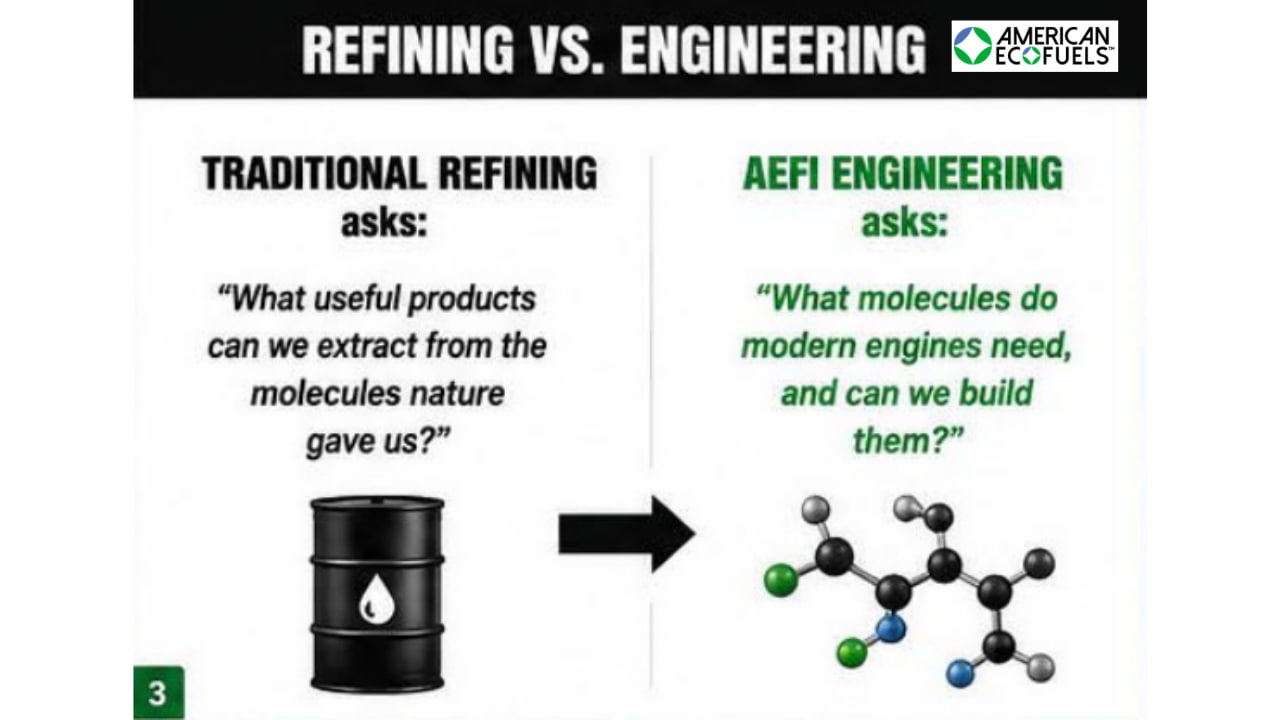
REFINING Fuel vs ENGINEERING Fuel
Greater control could potentially allow fuel developers to target characteristics such as:
- Energy density
- Weight
- Stability
- Cold-weather performance
- Combustion quality
- Sulfur content
- Soot-forming components
- Compatibility with existing engines and infrastructure
This does not mean every engineered fuel will automatically outperform petroleum.
Performance must be demonstrated through testing, certification, production, and real-world operation.
But it changes what may be possible.
Instead of asking machines to accept whatever fuel nature happens to provide, engineers can attempt to build fuel for the demands of the machine.
Why Not Replace Everything With Batteries?
Battery power has already transformed passenger vehicles and many smaller machines.
But some of the equipment supporting the global economy has much more demanding energy requirements.
Commercial aircraft must carry their energy into the sky. Ocean-going vessels travel enormous distances. Military vehicles must operate in remote and unpredictable environments. Heavy equipment and backup generators may need to run for long periods without access to charging infrastructure.
For these applications, liquid fuel provides a powerful combination of energy density, portability, rapid refueling, and compatibility with an enormous installed base of equipment.
Replacing all those machines could mean redesigning engines, manufacturing new fleets, rebuilding fueling networks, and replacing infrastructure around the world.
That would be extraordinarily expensive and could take decades.
The Drop-In Fuel Opportunity
A drop-in fuel is designed to work within existing engines and infrastructure after satisfying the necessary specifications and approvals.
That creates a potentially simpler path to adoption.
Instead of telling the world to replace its aircraft, trucks, ships, generators, storage tanks, pipelines, and fueling systems, a drop-in approach seeks to improve what flows through them.
The world may not need entirely new machines.
It may simply need a better fuel.
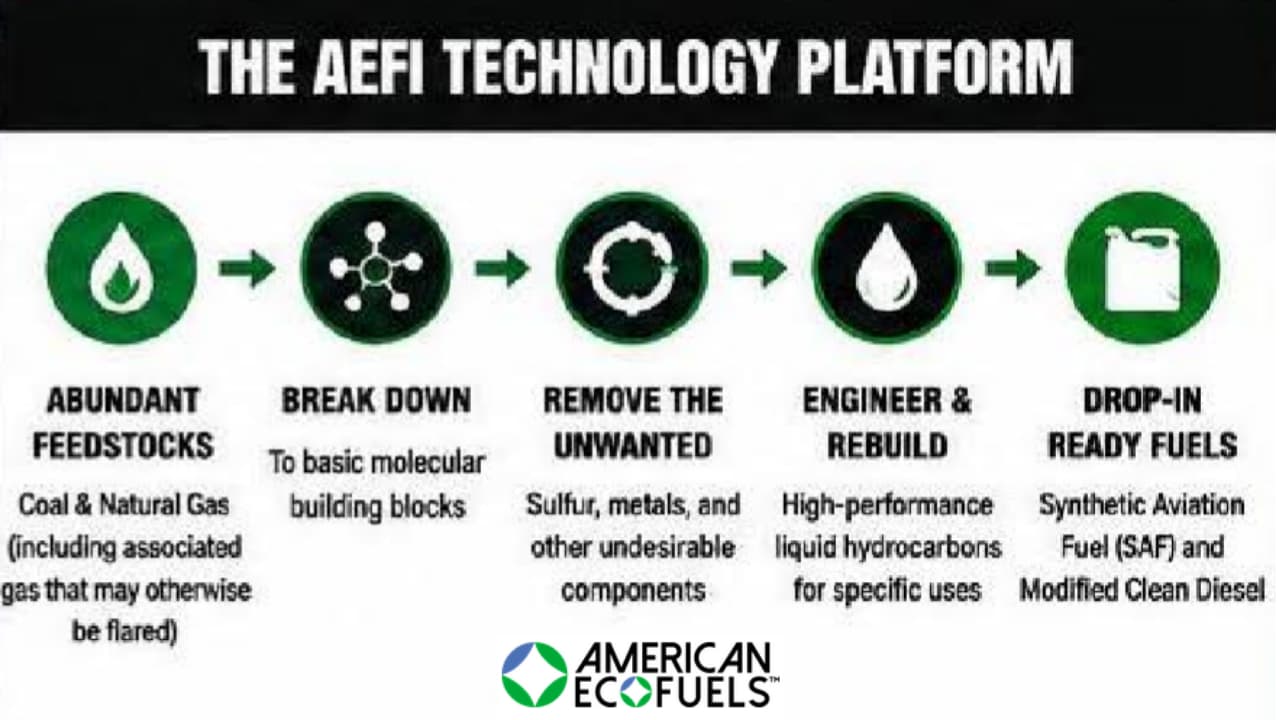
How AEFI Differs From Many SAF Companies
Sustainable aviation fuel, commonly called SAF, is becoming an important part of aviation’s attempt to reduce its environmental impact.
Many SAF producers use materials such as used cooking oil, vegetable oil, and animal fat as feedstocks.
Those materials are processed and upgraded into fuel suitable for blending with conventional jet fuel.
That approach is important, but the available supply of those feedstocks is limited.
Airlines cannot create unlimited quantities of used cooking oil or animal fat simply because demand for SAF increases.
American EcoFuels™ is pursuing a different starting point.
Instead of upgrading naturally occurring fats and oils, AEFI proposes using CTL and GTL processes to break coal and natural gas into basic ingredients and synthesize liquid hydrocarbons.
Many SAF Producers Upgrade an Existing Oil
These producers begin with cooking oil, vegetable oil, animal fat, or another biological material and refine it into aviation fuel.
AEFI Aims to Build Fuel From Molecular Ingredients
AEFI begins with coal or natural gas.
The feedstock is broken into smaller building blocks. Undesirable components are removed. The remaining ingredients can then be reconstructed into synthetic fuel.
Both approaches are trying to produce usable liquid energy.
But they begin with different raw materials and use different production pathways.
Why Aviation May Be the Ideal First Market
The aviation industry has a problem that cannot be solved easily by adding a larger battery.
Aircraft need tremendous amounts of energy without carrying excessive weight.
They must also operate through a global network of existing airplanes, airports, fuel tanks, pipelines, and maintenance systems.
That makes aviation one of the clearest markets for high-performance liquid fuels.
Airlines are also facing growing pressure from governments, customers, and corporations to reduce aviation-related emissions.
This has created demand for new aviation fuels before enough production exists to satisfy the potential market.
An engineered synthetic fuel that can satisfy technical standards, achieve regulatory acceptance, scale economically, and work with existing aviation infrastructure could address a valuable market.
Those are major conditions, however.
Producing fuel in a laboratory is not the same as manufacturing it economically at commercial scale.
AEFI May Be More Than an Aviation-Fuel Story
Aviation may be the most visible application, but the larger opportunity could be the platform.
If a molecular engineering process can produce hydrocarbons with different characteristics, the underlying technology may eventually address multiple hard-to-electrify markets.
Potential applications could include:
- Commercial and military aviation
- Cargo ships and other marine vessels
- Long-haul trucking
- Heavy agricultural and construction equipment
- Military vehicles
- Freight trains
- Industrial and emergency generators
Each market has different specifications, economics, regulatory requirements, and performance demands.
A fuel designed for an aircraft is not automatically suitable for every other application.
Nevertheless, the platform concept is important.
American EcoFuels™ may not be pursuing only one product.
It may be developing a method for engineering multiple fuels for different machines.
That is a much larger story than selling another gallon of a commodity.

The Silicon Analogy
Sand was never valuable because it looked like a computer chip.
It became valuable when humanity learned how to isolate, purify, and engineer silicon into a material that could control electricity.
That transformation helped launch the computing revolution.
Coal and natural gas should not be confused with silicon. Manufacturing fuel is very different from manufacturing semiconductors.
But the analogy provides a useful mental bridge.
The value may not lie solely in the raw material.
The value may lie in what engineering allows that material to become.
Nature created the ingredients. Humans discovered them.
The next step may be learning how to redesign what those ingredients become.
What American EcoFuels™ Must Prove
The Fuel 2.0 vision is ambitious.
Investors should also understand the difference between an exciting scientific concept and a commercially successful energy business.
AEFI must advance through several difficult stages.
1. Validate the Fuel
The company must demonstrate that its fuel performs as intended and consistently satisfies the necessary technical specifications.
2. Complete Testing and Certification
Aviation and other transportation markets require extensive testing, documentation, regulatory review, and industry acceptance.
3. Move From the Laboratory to Commercial Production
A process that works in small quantities must be translated into a reliable manufacturing system capable of producing much larger volumes.
4. Demonstrate Competitive Economics
The final fuel must compete within an industry where feedstock costs, plant costs, energy requirements, financing, incentives, and market prices all matter.
5. Secure Capital and Commercial Partners
Large-scale fuel production can require substantial capital.
Engineering firms, technology licensees, feedstock partners, fuel buyers, and project financiers could all play important roles.
These are not minor details.
They are the bridge between Fuel 2.0 as a compelling idea and Fuel 2.0 as a commercial product.
Why Investors May Want to Watch AEFI
When investors hear the word fuel, they often think of a commodity.
That reaction is understandable.
Traditional fuel companies usually compete through access to resources, refining capacity, distribution, production volume, and price.
But American EcoFuels™ may require investor to use a different mental model.
The company is attempting to develop a molecular engineering platform that could turn coal and natural gas into synthetic liquid fuels designed for modern machines.
If successful, AEFI would not merely be extracting another source of energy.
It would be participating in a broader transition:
From accepting nature’s fuel recipe to engineering fuel for a purpose.
The opportunity is potentially significant, but so are the risks.
AEFI remains an early-stage company pursuing a capital-intensive technology that must still navigate testing, certification, scale-up, financing, and commercialization.
Investors should evaluate both sides of that equation.
The Evolution From Extracting Energy to Engineering It
Humanity’s first energy revolution began when we learned to control fire.
The next chapters were written by coal, crude oil, natural gas, refining, and the machines those resources made possible.
For more than a century, we kept improving the machine.
We built faster aircraft, larger ships, more powerful trucks, advanced military vehicles, and generators capable of supporting hospitals and data centers.
But the basic relationship remained the same.
We engineered machines around fuels derived from what nature gave us.
American EcoFuels is asking whether it is finally time to reverse that equation.
What if we could engineer fuel around the machine?
What if coal and natural gas could be treated as molecular building materials rather than fuels that must simply be burned in their original form?
What if the next generation of liquid energy is not merely discovered, drilled, or refined?
What if it is designed?
That is Fuel 2.0.
And that is the potential American EcoFuels™, ticker AEFI, is pursuing.
INVESTOR DISCLOSURE
This article is for informational purposes only and is not financial advice. American EcoFuels™ is a development-stage company, and many of its plans and expected benefits remain subject to technical, regulatory, financing, certification, and commercialization risks. Conduct your own research before making any investment decision.
American EcoFuels™ is an early-stage public company. Its technology, proposed fuels, production plans, commercial opportunities, and potential performance remain subject to technical, regulatory, financing, scale-up, market, and execution risks.
Laboratory progress does not guarantee certification, economical commercial production, customer adoption, or investment returns.
Investors should review the company’s public filings, verify company statements independently, and consider their own risk tolerance before making an investment decision.
This blog post contains forward-looking statements and speculative analysis. This content is for informational purposes only and does not constitute investment advice. American EcoFuels ™ (AEFI) is a publicly traded company; investors should review all SEC filings and consult a financial advisor before making investment decisions.
Disclaimer:
This communication is a paid advertisement for American EcoFuels™ Inc. to enhance public awareness of the Company, its products, its industry, and its potential as an investment opportunity. This communication is not intended as, and should not be construed to be, an offer to sell or a solicitation of an offer to buy any security.
Real Creative Agency, and their owners, managers, employees, and assigns were paid by the Company to create, produce, and distribute this advertisement. This compensation should be viewed as a major conflict for this presentation to be unbiased.
On July 1, 2026, American EcoFuels™ Inc. agreed to pay Scott Shaffer $2,500 per month for 6 months.
This communication is not intended as, and should not be construed to be, an offer to sell or a solicitation of an offer to buy any security. Neither this communication nor the Company purports to provide a complete analysis of the Company or its financial position. The Company is not, and does not purport to be, a broker-dealer or registered investment adviser. This communication is not, and should not be construed to be, personalized investment advice directed to or appropriate for any particular investor. Any investment should be made only after consulting a professional investment advisor and only after reviewing the financial statements and other pertinent corporate information about the Company. Further, readers are advised to carefully consider the Risk Factors identified and discussed in the government filings. Investing in securities is speculative and carries a high degree of risk.
Real Creative Agency

EMERGING TECHNOLOGY CONSULTANTS
Helping emerging technology companies since 2005.