
Published: June 17, 2026 | Published By: Real Creative Agency
Could American Fusion™ (OTC: AMFN) and its Texatron™ Achieve the “Holy Grail of Energy“?
American Fusion™ is publicly traded company under the symbol AMFN
Physicists and engineers have pursued fusion energy for over seventy years, and for good reason. Fusion is the same process that powers the stars: two light atomic nuclei collide and merge, releasing enormous amounts of energy.
But within the world of fusion, there exists an even more elusive prize, aneutronic fusion.
Most fusion reactions, including those pursued by large government programs like ITER, produce high-energy neutrons as a byproduct. Those neutrons are a problem. They irradiate reactor walls, make materials radioactive over time, require enormous shielding, and ultimately must be converted into heat and then electricity via a conventional steam turbine, a costly, inefficient process that looks a lot like a very expensive kettle.
Aneutronic fusion is different. It uses fuel combinations: most notably hydrogen and boron-11, which produce no neutrons in their primary reaction.
The byproduct is helium. The energy is released as charged particles, which can be converted into electricity with efficiencies that dwarf anything conventional energy can offer.
No radioactive waste. No meltdown risk. No neutron bombardment. No cooling towers.
Virtually limitless fuel from abundantly available materials. Clean, direct, near-perfect energy.
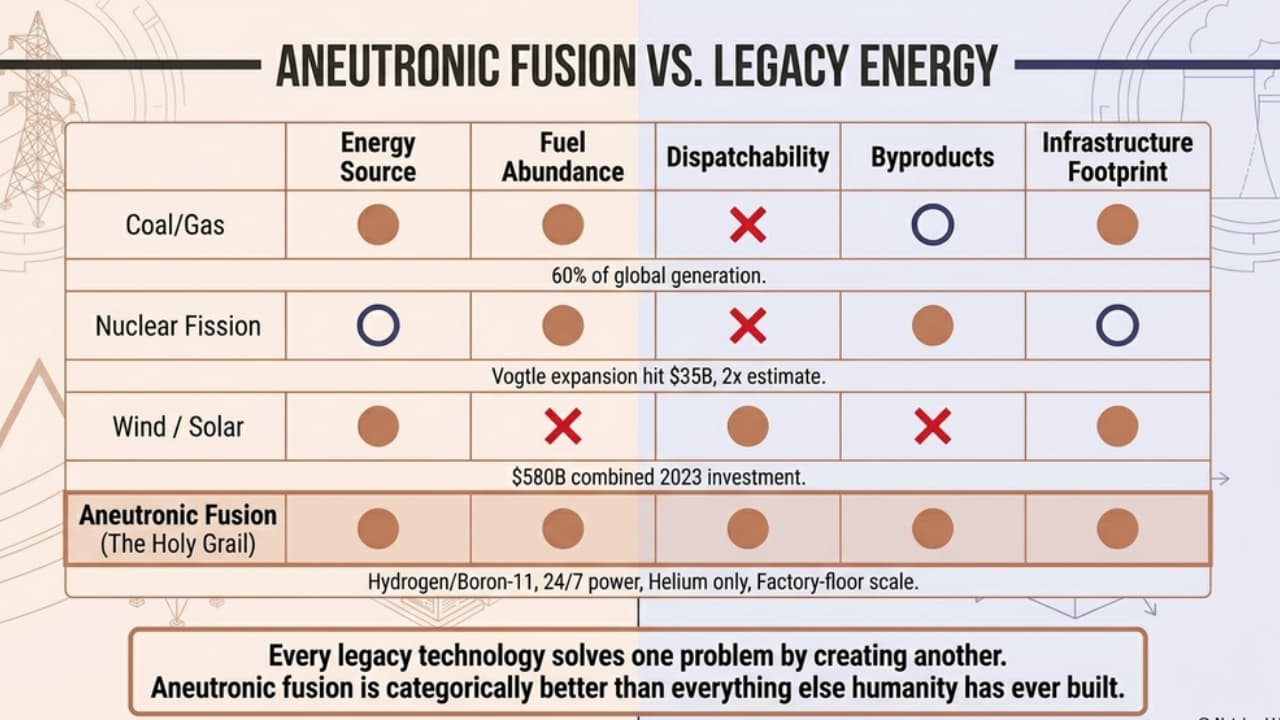
That is why the scientific community calls it the holy grail. Not because it is merely good, but because, if achieved, it would be categorically better than everything else humanity has ever built to generate power.
(Please see our initial report on American Fusion™ AMFN)
How The World Makes Electricity Today
To understand what aneutronic fusion could mean, it helps to grasp the landscape it would enter.
Coal and Natural Gas remain the world’s dominant electricity sources, accounting for roughly 60% of global generation.
They work by burning fuel to create heat, boiling water into steam, and spinning a turbine. They are reliable and dispatchable. You can turn them on when you need them, but they emit carbon dioxide, contribute to climate change, and are subject to the volatile geopolitics of fuel supply chains.
Nuclear Fission splits heavy atoms like uranium rather than fusing light ones.
It produces no carbon emissions during operation and generates enormous amounts of power from small amounts of fuel.
But it produces long-lived radioactive waste, carries the specter of catastrophic accidents, and faces decades-long permitting and construction timelines.
New nuclear plants in the West have struggled enormously with cost overruns. For example, the Vogtle expansion in Georgia came in at nearly $35 billion, more than twice its original estimate.
Hydroelectric Power harnesses the energy of falling water and is the world’s largest source of renewable electricity.
It is clean, reliable, and has been refined over more than a century. But it is geographically constrained. You need the right rivers and the right terrain, and large dams carry high environmental and social costs.
Wind Energy has scaled dramatically over the past two decades.
The cost of onshore wind power has dropped by roughly 70% since 2010, making it one of the cheapest sources of new electricity in many regions. Investment poured in: global wind investment exceeded $200 billion in 2023 alone.
But wind is intermittent, with only 30% efficiency. It doesn’t blow on command, and the infrastructure required to transmit it from windy rural regions to population centers is expensive and politically contentious.
Solar Energy is perhaps the most dramatic energy investment story of the modern era.
The cost of solar photovoltaic panels has fallen by more than 90% since 2010, transforming what was once an exotic technology into the cheapest source of electricity ever measured in many parts of the world. Investment followed: global solar investment surpassed $380 billion in 2023, overtaking oil and gas upstream investment for the first time.
Entire industries were built, stock markets moved, and energy grids were transformed. Solar is extraordinary, but it only works when the sun shines.
Storage and grid management costs add significant complexity and expense. And even at a massive scale, solar still requires enormous land areas and manufacturing supply chains, and depends on weather and geography.
Each of these technologies solved real problems and created real wealth for investors and the industries that backed them early. Each also carried fundamental limitations that the next generation of technology is still working to overcome.
The Risk- Aneutronic Fusion Has Never Been Done
Before going further, honesty demands a clear-eyed accounting of where aneutronic fusion actually stands.
It has never been done. Not at laboratory scale. Not in a controlled demonstration.
The hydrogen-boron reaction requires plasma temperatures exceeding one billion degrees Celsius, roughly seventy times hotter than the core of the sun.
Sustaining those temperatures long enough, in a configuration stable enough, to extract net energy is a challenge that has defeated every attempt made so far.
Plasma physics is brutally complex.
The engineering required to contain billion-degree plasma, extract energy from charged particles efficiently, and build a system that produces more energy than it consumes is at the absolute frontier of human capability.
This means AMFN is not merely a “fusion science” ticker.
It is attaching itself to one of the biggest hidden infrastructure narratives of the decade.
Several serious companies and research groups are pursuing it, including TAE Technologies, HB11 Energy, and others… but none have demonstrated net energy gain.
The science suggests it is possible. The engineering has yet to catch up.
Investors and observers should hold both truths simultaneously: aneutronic fusion is the most compelling energy prize in human history, and it is an exceptionally high-risk bet that may take decades more to realize, or may not be achieved in the expected form at all.
—————————————————————-
Capital allocated here should be patient, diversified, and held with eyes open.
—————————————————————–
This is frontier science, not infrastructure investment.
What makes it worth discussing and investing in monitoring, even at this stage, is the magnitude of what success would mean.
The Sun Is a Free Fusion Reactor In The Sky
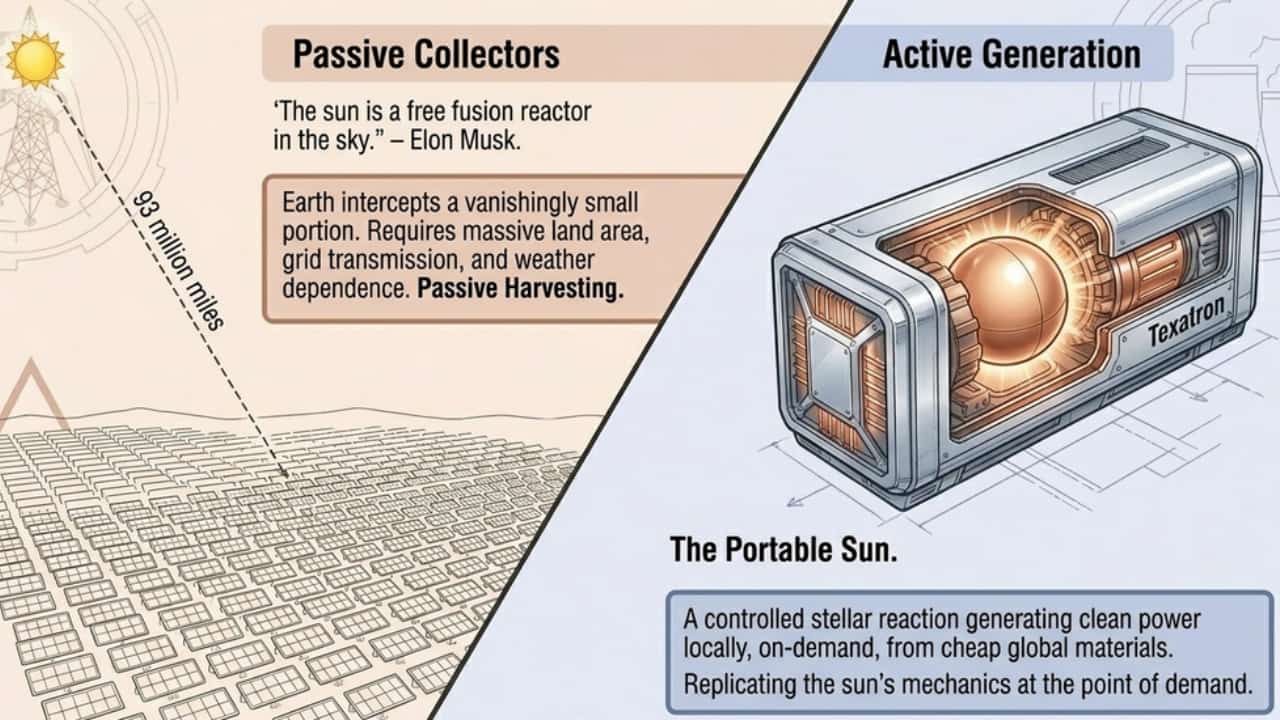
Elon Musk has described the sun as a “free fusion reactor in the sky,” noting that capturing an extremely tiny fraction of its energy output would be more than sufficient to power all of human civilization.
He is right. The math is staggering.
The sun radiates approximately 3.8 × 10²⁶ watts of power. Earth intercepts a vanishingly small portion of that. Of that, only a fraction reaches the surface usefully. And yet solar panels, spread across a relatively modest portion of desert land globally, could theoretically meet all of humanity’s energy needs.
The sun is so absurdly powerful that proximity to it, in energy terms, is an almost embarrassing gift.
But Musk’s framing also reveals the limitation.
The sun is 93 million miles away.
Even capturing a tiny fraction of its output requires covering meaningful land area with panels, building continent-spanning grids, managing intermittency, and accepting that clouds, seasons, and geography all constrain the yield.
The sun is free. Everything required to use it is not.
Texatron™ and the Concept of a Portable Sun
If a company like American Fusion™ were to achieve aneutronic fusion with Texatron™, the physics of what they would have built could reasonably be described as a “portable sun.”
Not metaphorically. Literally.
A controlled stellar reaction that is contained, stable, and generates clean power from deuterium and helium-3, in a package that sits on a factory floor, a military base, a hospital campus, or a ship.
Think of a Texatron™ as a possible next generation “Generac” that can run 24/7.
No fuel supply chain beyond materials that are cheap and globally abundant. No emissions. No cooling towers. No radioactive waste requiring century-scale management. No grid dependency.
Now consider what that would mean at scale.
Musk is correct that we don’t need to replicate the sun; we just need a tiny fraction of what it produces. But the brilliant insight embedded in aneutronic fusion is that you don’t need to capture that fraction from 93 million miles away across an enormous land-based infrastructure.
You could generate it locally, on demand, wherever you need it.
Imagine if American Fusion doesn’t just achieve aneutronic fusion, but manufactures it.
Not a single demonstration in a national laboratory, but units produced at scale, engineered for reliability, and deployed like any other capital equipment.
Power generation as a product…their business model is expected to be Power as a Service.
Energy independence not as a grid-level abstraction but as something a city, a factory, a military installation, or eventually a neighborhood could simply own.
Think of what Generac did for backup power.
During hurricanes, ice storms, and grid failures, Generac standby generators became a practical, purchasable solution to energy vulnerability.
Homeowners, businesses, and data centers installed them by the millions.
Generac’s stock rose more than 1,000% between 2019 and 2021 as grid reliability concerns grew and extreme weather became more frequent.
Now scale that concept by orders of magnitude. The world is heading into a period of profound energy stress: AI data centers are consuming electricity at rates that are doubling every few years, electrification of transportation is accelerating demand, aging grid infrastructure is failing under climate stress, one branch of the military estimates a current shortage of 1.65 terawatts of power, just here in the US. and geopolitical fragility is exposing the cost of energy dependency.
An analogy.
Solar panels are essentially collectors. They sit in one place and wait for energy to arrive.
Texatron™ aims to be something entirely different. Think of it as a portable Generac powered by the same force that powers the sun. Instead of harvesting energy, it creates it wherever it’s needed
The need for distributed, reliable, abundant power is not a future scenario. It is the present reality, intensifying every year.
A manufacturable aneutronic fusion unit, one that could be sited anywhere, fueled cheaply, and operated with minimal specialized expertise, would not be a product. It would be a platform.
The kind of platform that reorganizes entire industries around it, the way the internal combustion engine reorganized transportation, or the microprocessor reorganized computing.
What to Watch with American Fusion™ AMFN
American Fusion (AMFN) exists at the intersection of this frontier.
The company is positioned to participate in the development and commercialization of aneutronic fusion technology, betting that what has never been done before can be done, and in a form the world can actually use.
The risks are real and should not be minimized. The timelines are uncertain. The physics remains deeply challenging.
Investors who engage with this space should do so with clarity about what they are holding: a “call option on a technology” that, if it works, renders most of the existing energy infrastructure obsolete.
The sun produces energy through fusion every second of every day. It has been doing so for 4.6 billion years.
Science is not in question. The engineering is.
And across the globe, a small number of serious teams are getting closer.
If one of them gets there, if a portable sun becomes manufacturable, the question will not be whether it changes the world.
The question will be who owned a piece of it.
Where American Fusion™ Stands Today
American Fusion is not waiting on the science; it is executing on an engineering roadmap.
The Company’s 5MW Pre-Production Texatron™ Fusion Engine™ is nearing completion at a third-party fabrication facility in Midland/Odessa, Texas, with delivery expected any day, and installation targeted at its Dallas-Fort Worth facility shortly thereafter.
The Company has already secured fuel supplies, both Deuterium and Helium-3, sufficient to power its full testing and validation program through the end of 2026, removing one of the key logistical uncertainties that plague early-stage energy ventures.
Testing is structured across five formal phases, from regulatory and infrastructure readiness through independent scientific validation, with management targeting completion of the full program by August 2026.
That validation phase is notable: results are intended to be reviewed by independent physicists and PhD-level scientists, with formal technical reports to follow.
The Company has also circulated a Letter of Intent to a Canadian mining company for a potential 20-megawatt Power Purchase Agreement spanning 20 years, a signal that industrial customers are not waiting for fusion to be perfect before positioning themselves around it. (Source)
This blog post contains forward-looking statements and speculative analysis. Aneutronic fusion has not yet been demonstrated at net energy gain and remains a pre-commercial technology. This content is for informational purposes only and does not constitute investment advice. American Fusion (AMFN) is a publicly traded company; investors should review all SEC filings and consult a financial advisor before making investment decisions.
The Best Way To Invest in Fusion?
Here is how Texatron™ could replace nuclear energy by end of 2026
Additional American Fusion™ Inc Material
Articles:
Kepler Fusion Investor Fact Sheet (Dec 2025)
Textatron™ Fusion Energy Platform White Paper (Jan ’25)
The Texatron™ Project (Aug ’25)
Harbinger Research Report Jan 2026
Independent Technical Review March 2026
YouTube Videos:
How Close Are We To Fusion Energy Commercialization
Clean Energy Just Got A Game Changer
American Fusion The Most Asymmetric Nuclear Bet
Disclaimer:
This communication is a paid advertisement for American Fusion™ Inc. to enhance public awareness of the Company, its products, its industry, and its potential as an investment opportunity. This communication is not intended as, and should not be construed to be, an offer to sell or a solicitation of an offer to buy any security.
This communication is a paid advertisement for American Fusion™ Inc. to enhance public awareness of the Company, its products, its industry, and as a potential investment opportunity. Real Creative Agency, and their owners, managers, employees, and assigns were paid by the Company to create, produce, and distribute this advertisement. This compensation should be viewed as a major conflict for this presentation to be unbiased.
On March 20, 2026, American Fusion™ Inc. agreed to pay Scott Shaffer $5,000 per month for 6 months.
This communication is not intended as, and should not be construed to be, an offer to sell or a solicitation of an offer to buy any security. Neither this communication nor the Company purports to provide a complete analysis of the Company or its financial position. The Company is not, and does not purport to be, a broker-dealer or registered investment adviser. This communication is not, and should not be construed to be, personalized investment advice directed to or appropriate for any particular investor. Any investment should be made only after consulting a professional investment advisor and only after reviewing the financial statements and other pertinent corporate information about the Company. Further, readers are advised to carefully consider the Risk Factors identified and discussed in the government filings. Investing in securities is speculative and carries a high degree of risk.
Real Creative Agency

EMERGING TECHNOLOGY CONSULTANTS
Helping emerging technology companies since 2005.