American EcoFuels™ Inc AEFI
American EcoFuels™ AEFI uses proprietary Coal-to-Liquid (CTL) and Gas-to-Liquid (GTL) technology to create drop-in ready Sustainable Aviation Fuel (SAF) and solve a critical industry bottleneck.
American EcoFuels™ A Publicly Traded Sustainable Aviation Fuel Stock
American EcoFuels™ (OTC:AEFI) is formerly known as Eco Innovation Group Inc. The company is advancing a transaction with Kepler GTL Technologies to strenghten its position in the Sustainable Aviation Fuel (SAF) market.
The transaction includes proprietary Gas-to-Liquids (GTL) technology that converts natural gas and other feedstocks into drop-in ready Sustainable Aviation Fuel and other low-carbon transportation fuels
More info: Kepler Aerospace Future Proofing the World with Game-Changing Technologies
American EcoFuels™ Inc AEFI
Price $0.0011 August 5, 2026
Ticker AEFI (Yahoo Finance)
Market Cap $9.05M
AEFI is Redesigning Carbon To Create the “Perfect Fuel”
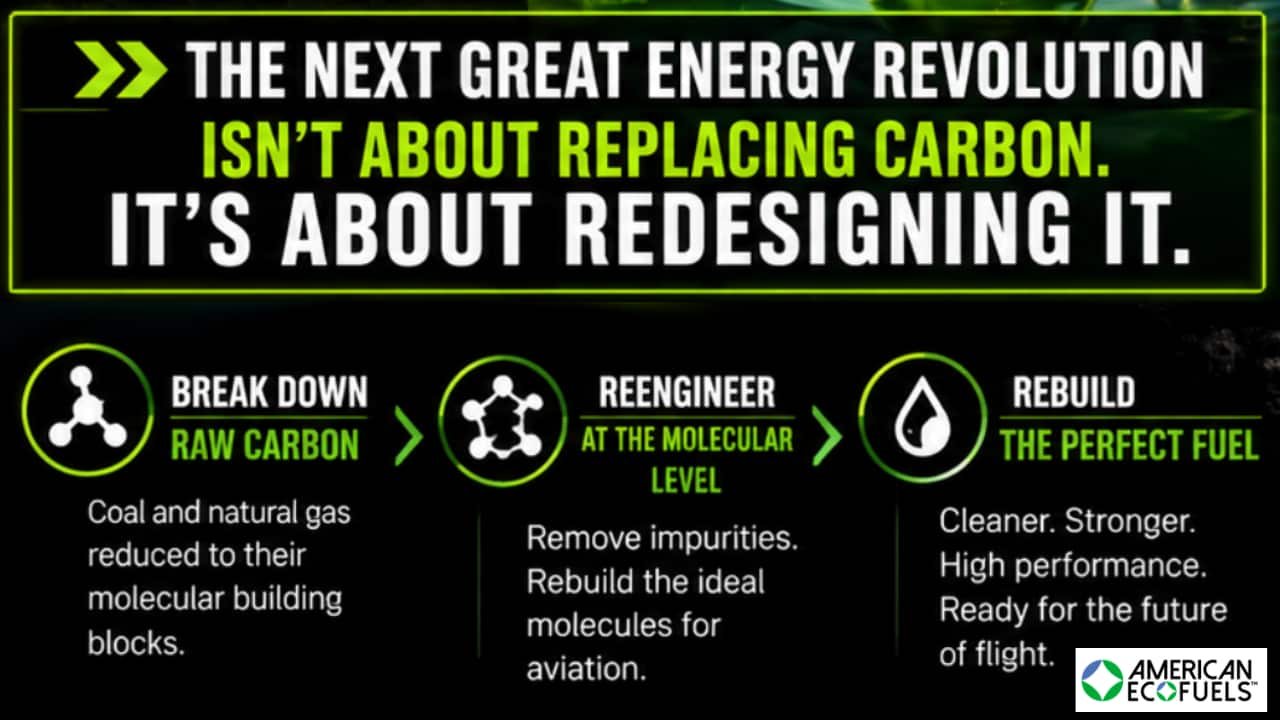
The next great energy revolution isn’t about replacing carbon. It’s about redesigning it.
American EcoFuels™ uses proprietary technology to break coal and natural gas down to their molecular building blocks, remove unwanted impurities, and rebuild them into cleaner, high-performance Sustainable Aviation Fuel.
As aviation searches for a replacement for conventional jet fuel, AEFI isn’t simply making fuel. It’s engineering what could become the next generation of liquid energy.
Ancient carbon locked in the ground (coal and gas) is volatile, dirty, and geographically locked. AEFI’s process acts as a digital-age furnace that liberates the carbon atom from its crude solid or gaseous state and restructures it into a high-density, drop-in liquid fuel.
AEFI is applying molecular alchemy to carbon.
They are transmuting raw fossil energy into a zero-sulfur, clean-burning aviation fuel that drops right into existing jet engines without requiring a single modification to aircraft or airport infrastructure.
The next generation of energy won’t be drilled or mined. It will be designed.
AEFI could do for carbon what the semiconductor industry did for silicon
American EcoFuel™: Powering the Future of sustainable aviation
The global aviation industry is at a critical crossroads: demand for Sustainable Aviation Fuel (SAF) is skyrocketing, yet supply remains virtually nonexistent.
American EcoFuels™ (AEFI), utilizing proprietary technology developed in-house at Kepler Aerospace, is positioned to solve the industry’s greatest challenge: the feedstock bottleneck.
By transforming abundant, stranded resources like flared natural gas and unwanted coal into high-performance synthetic fuels, AEFI is unlocking the next generation of flight.
SOLVING the Global Sustainable Fuel (SAF) Supply Bottleneck
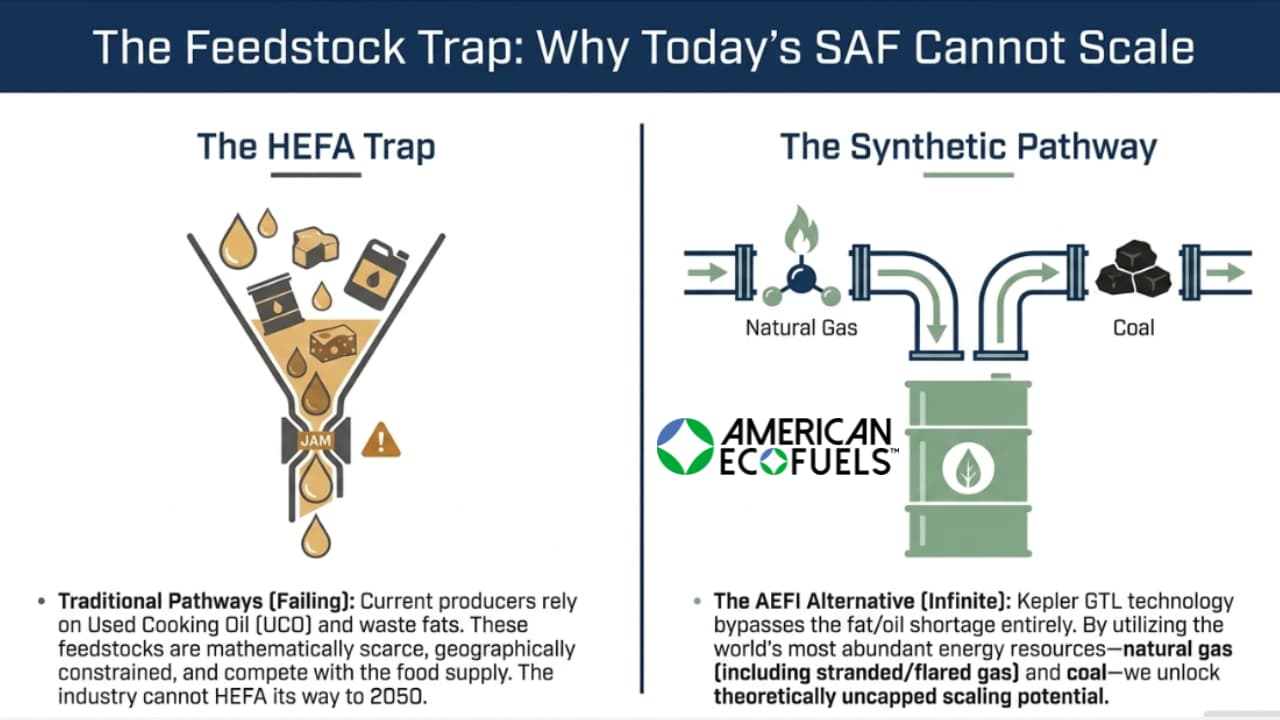
Beyond HEFA; Why Fats and Oils Can’t Scale to Meet 449 Billion Liters
HEFA stands for Hydroprocessed Esters and Fatty Acids (also called Hydrotreated Esters and Fatty Acids), which is a key industrial process used to turn waste oils, animal fats, and plant oils into green jet fuel.
Traditional SAF production relies on the HEFA pathway, utilizing scarce fats, oils, and greases, which currently account for less than 1% of global jet fuel consumption.
These feedstocks are expensive, limited, and fundamentally unable to scale to the 449 billion liters required by 2050.
AEFI provides a “different pathway” by leveraging abundant hydrocarbon inputs to produce massive volumes of synthetic fuel.
Meeting the Mandate: Bridging the Gap to IATA Net-Zero 2050
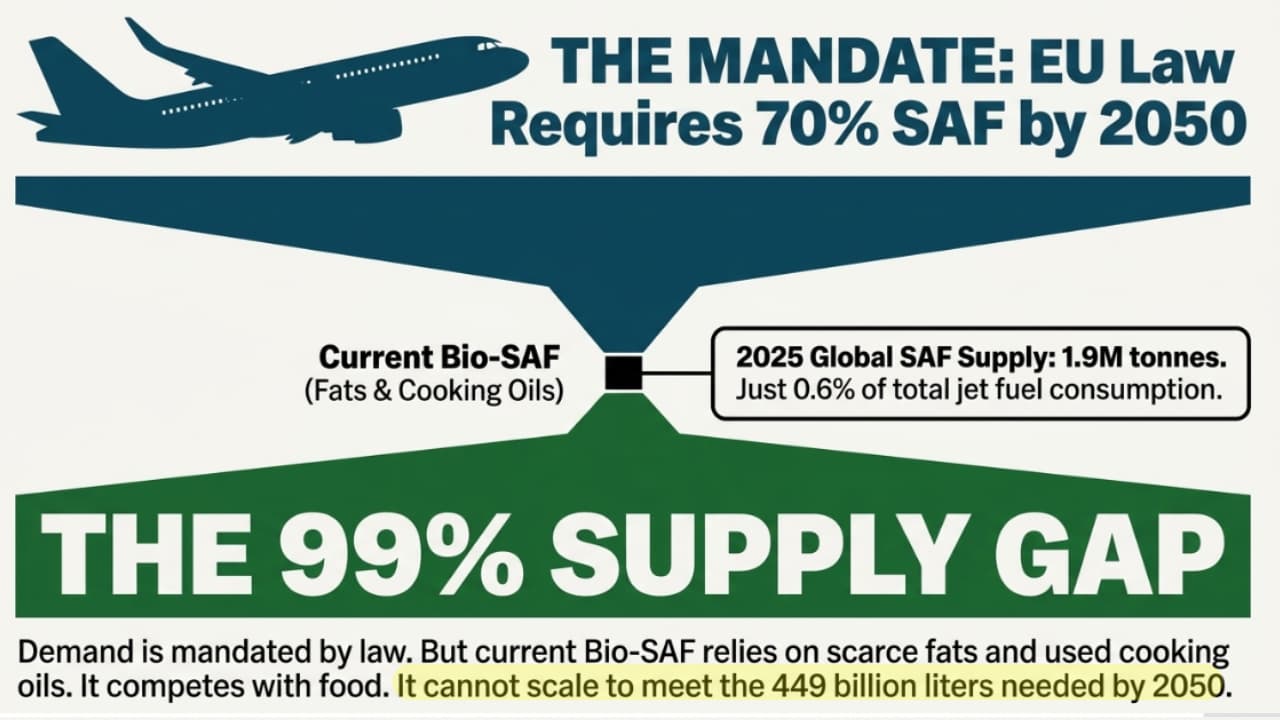
Global aviation is legally required to transition; the ReFuelEU mandate alone requires SAF shares to rise from 2% in 2025 to 70% by 2050. With less than 0.03% of commercial aircraft currently burning SAF,
AEFI’s scalable production is the only viable way to close this staggering 99% supply gap.
Sustainable Aviation FUel Is Also Referred to as a “Ghost Commodity”
The reason some investors call Sustainable Aviation Fuel (SAF) a “ghost commodity” is because it behaves like a commodity, but most people don’t realize it exists, can’t buy it directly, and don’t see it being traded the way they see oil, gold, copper, or wheat.
Oil is a visible commodity.
Everyone knows what it is, sees gas stations, and understands demand.
SAF is an invisible commodity.
Airlines desperately need it, governments are mandating it, corporations are buying it, yet almost nobody outside the aviation industry talks about it.
It’s described as a “ghost commodity” because it is creating billions of dollars of demand, but it remains largely hidden from public view.
The Airline Industry Isn’t The Only BUyer of Saf
SAF Demand Extends Far Beyond Airlines
Most investors think airlines are the only buyers of Sustainable Aviation Fuel. They’re not.
Big Tech like Google, Microsoft, and Amazon are also purchasing SAF to offset emissions from business travel and meet sustainability commitments, even though they don’t own aircraft. (Google just signed a record breaking sustainable aviation fuel agreement)
This creates a powerful second layer of demand, transforming SAF from an aviation fuel into a strategic commodity sought by airlines, corporations, and potentially even the military.
Proprietary Gas-to-Liquids (GTL) & Coal-to-Liquids (CTL) Technology
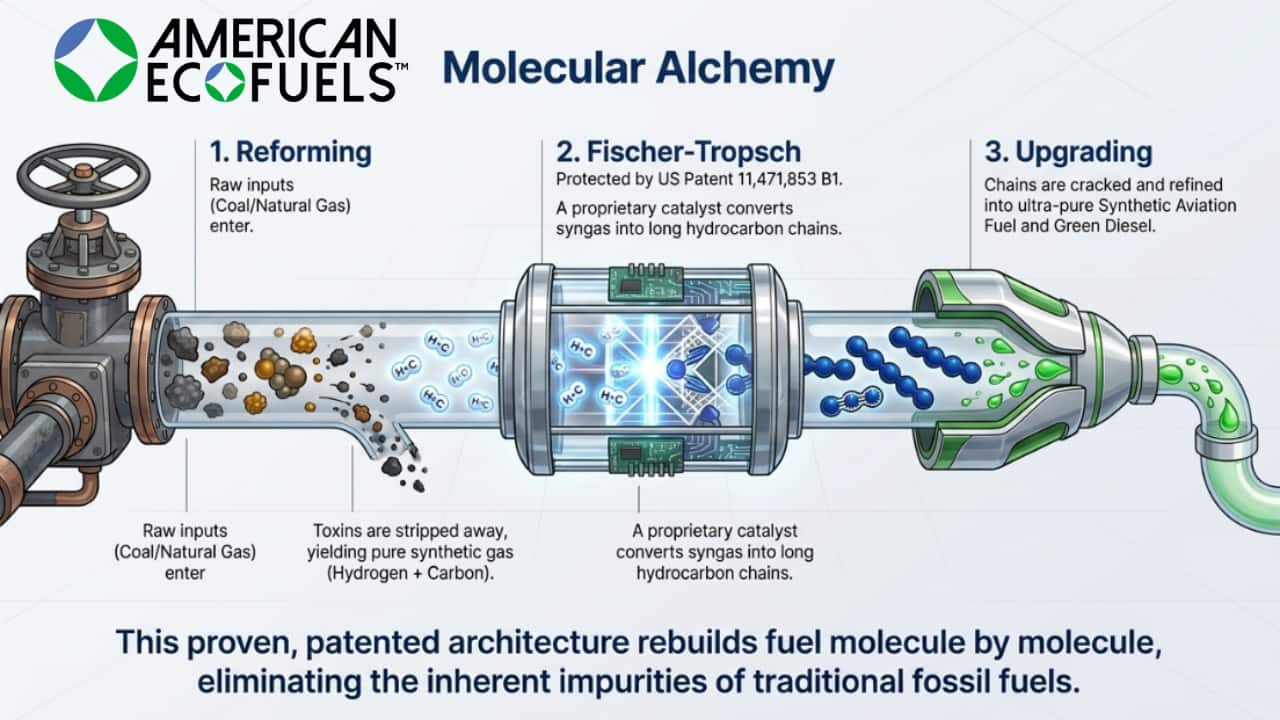
Molecular Alchemy: Transforms Undesirable Carbon Source into a Valuable, Engineered Fuel Molecule
It’s not just fuel, it’s an ENGINEERED MOLECULE.
Instead of treating coal and flared gas as waste products, its technology converts these overlooked carbon sources into engineered sustainable aviation fuel molecules designed for the next generation of aviation.
Today:
Flared gas = wasted energy
Coal = stranded carbon asset
Carbon emissions = environmental problem
AEFI’s vision:
Flared gas + carbon resources → engineered liquid fuel → aviation energy solution
AEFI’s technology isn’t a “science project”; it is a proven platform by Kepler GTL and exclusive licenses.
Their proprietary catalytic chemistry breaks down feedstocks to their core elements of pure hydrogen and carbon before rebuilding them into the world’s cleanest synthetic fuels.
Decarbonizing at the Source: Turning Flared Gas and “Unwanted” Coal into Pure Energy
AEFI offers TWO sustainable aviation fuel solutions:
- They take carbon problems, like flared natural gas in the Midland, Texas hub or stranded coal, and turn them into high-value energy.
- Their Coal-to-Liquids (CTL) process repurposes unwanted coal into “Green Jet Fuel” while removing harmful chemicals at the molecular level before they can enter the atmosphere.
Modular and Scalable: Plug-and-Play Infrastructure for Rapid Global Deployment
Unlike traditional multi-billion-dollar refineries, their modular design allows for faster expansion, portability, and deployment directly at gas hubs or remote resource sites. This flexibility allows AEFI to monetize assets that would otherwise be uneconomic or environmentally hazardous.
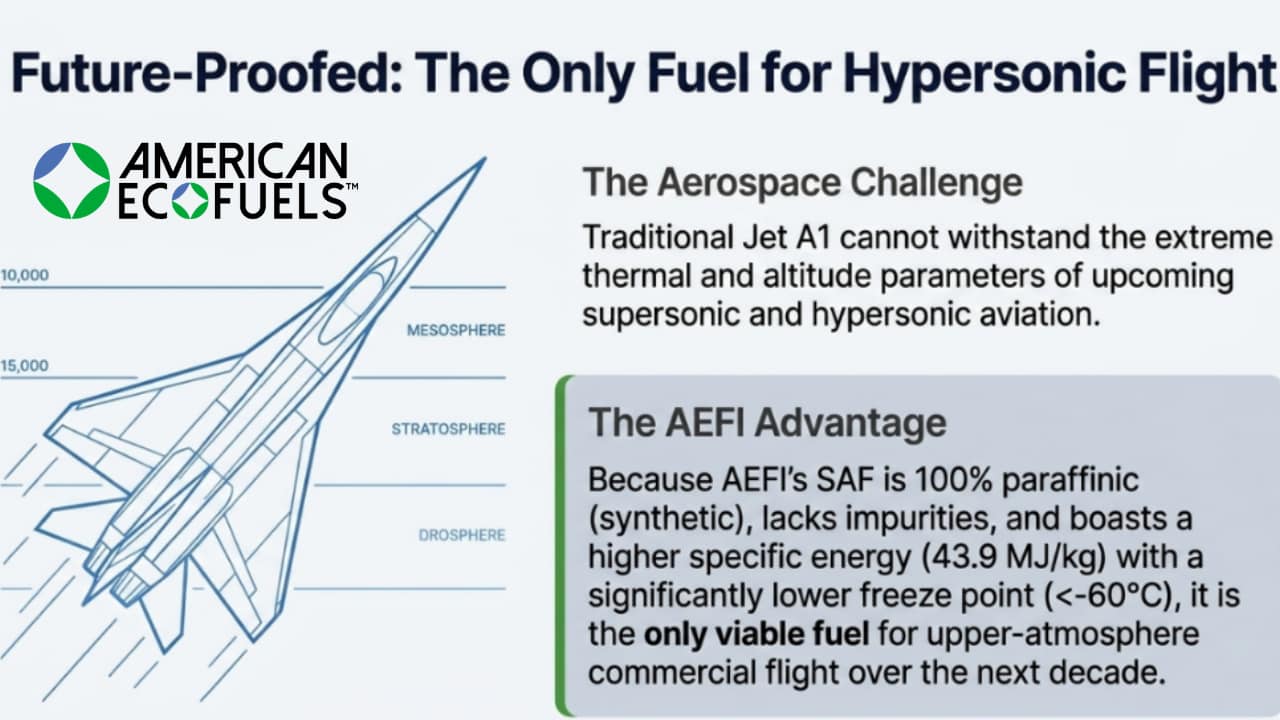
High-Performance Synthetic Fuel: Better than Jet A1
Drop-In Ready: No Blending or Engine Adaptations Required
AEFI produces a “drop-in” ready fuel that is 100% compatible with today’s aircraft engines and infrastructure. Unlike other alternatives, their synthetic SAF requires no blending with traditional fossil fuels, allowing airlines to meet their emissions goals immediately.
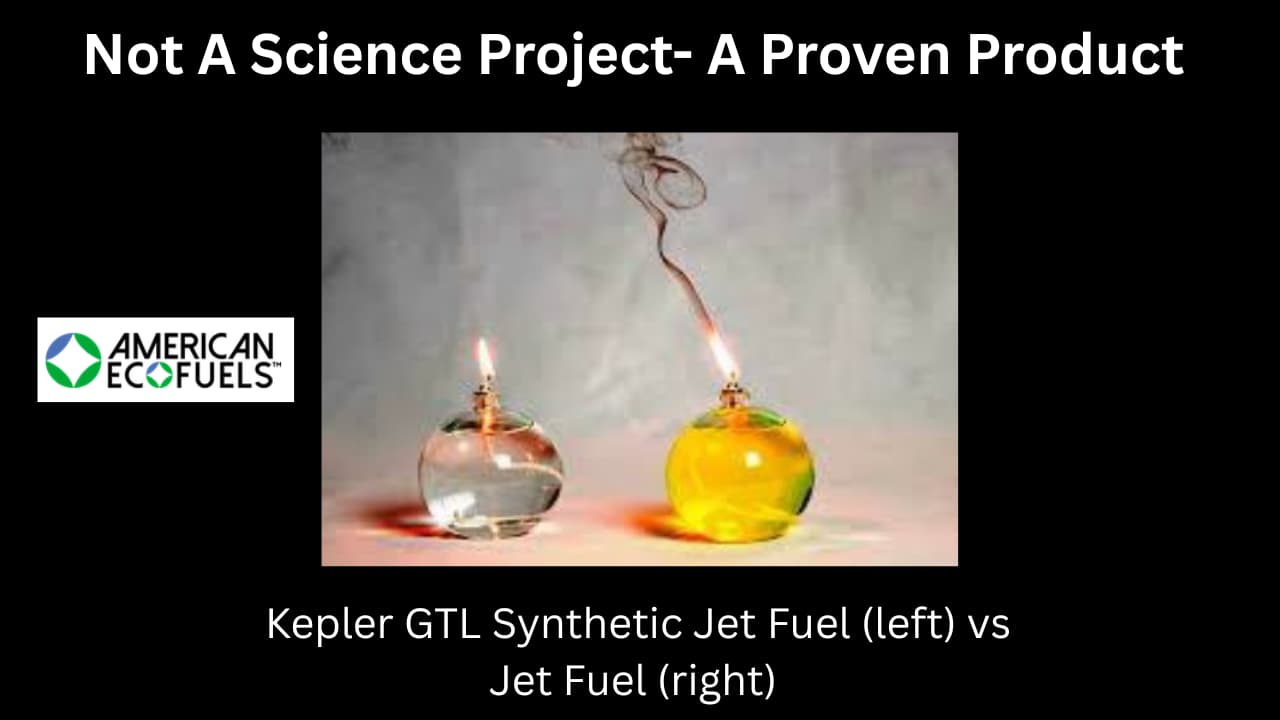
More Payload, More Range: 7.5% Lighter with 2% More Energy
Their synthetic SAF is technically superior to petroleum-based Jet A1, weighing between 5.6% and 7.5% less while providing approximately 2% more energy per gallon.
For airlines, this translates directly into increased payload capacity and extended flight range.
The Future of Flight: Optimized for Supersonic and Hypersonic Aviation
Due to its high energy density and extreme purity, AEFI fuel is positioned as the primary solution for the next generation of supersonic and hypersonic flight.
As these high-speed aircraft emerge over the next five years, they will require the thermal stability and power that only high-quality synthetic SAF can provide.
Beyond Net-Zero: A Total Environmental Solution
Removing 2.7 Million Tons of CO2 Annually Per Facility
Each standard AEFI facility acts as an environmental filter, repurposing approximately 2,700,000 tons of CO2 annually.
Their planned “mega plants” are designed to remove up to 12 million tons of CO2 every year, providing a massive, scalable impact on global carbon levels.
Eliminating Toxins: 0% Sulfur and 0% Methane
Their synthetic fuels set a new global standard for purity by eliminating the toxins that cause acid rain and respiratory illness.
AEFI fuel contains 0% Sulfur Dioxide (SO2), 0% Methane (CH4), and 0% Volatile Organic Compounds (VOCs).
Self-Sustaining Operations: Zero External Water and Power Consumption
A hallmark of their technology is operational efficiency; once started, their process requires no external water or electricity.
Their facilities are net-energy positive, generating enough excess clean power to provide electricity to local communities.
The AEFI Opportunity: Capturing a Mandated Multi-Billion Dollar Market
Navigating Global Mandates: Capitalizing on the ReFuelEU 70% Requirement
The market for SAF is legally mandated, creating a guaranteed multi-decade demand cycle.
The Economics Flywheel: Turning Environmental Waste into High-Value Synthetic Assets
AEFI’s business model targets an EBITDA of 75%, converting low-cost or waste feedstocks into high-value synthetic fuels.
Each standard facility is projected to generate over $191 million in annual revenue, creating a powerful economic engine for shareholders
Strategic Energy Security: Domestic Production for a Resilient Future
By producing fuel domestically near stranded assets, AEFI improves national energy security and reduces reliance on volatile global supply chains.
American EcoFuels™ (AEFI) is set to power the next generation of flight and unlock one of the largest energy transitions in history.
The FUTURE MAY NOT BELONG To the companies that discover energy. It May belong to the ones that redesign it.
The world doesn’t have a shortage of carbon.
It has a shortage of cleaner ways to use it.
American EcoFuels™ is applying molecular engineering to one of the hardest energy challenges on Earth, commercial aviation.
If successful, the company’s greatest innovation won’t be producing another fuel. It will be proving that the next generation of energy can be engineered instead of extracted.
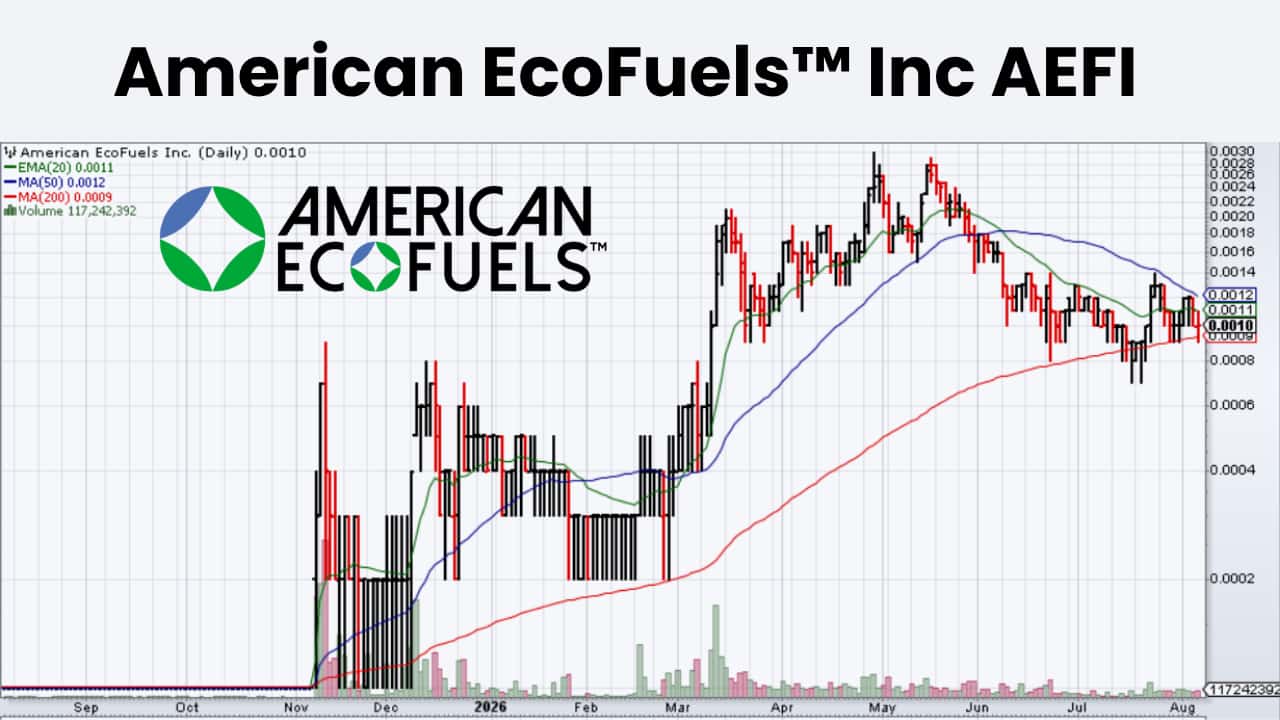
AEFI August 6, 2026 Price $0.0010
Disclaimer:
This communication is a paid advertisement for American EcoFuels™ Inc. to enhance public awareness of the Company, its products, its industry, and its potential as an investment opportunity. This communication is not intended as, and should not be construed to be, an offer to sell or a solicitation of an offer to buy any security.
Real Creative Agency, and their owners, managers, employees, and assigns were paid by the Company to create, produce, and distribute this advertisement. This compensation should be viewed as a major conflict for this presentation to be unbiased.
On July 1, 2026, American EcoFuels™ Inc. agreed to pay Scott Shaffer $2,500 per month for 6 months.
This communication is not intended as, and should not be construed to be, an offer to sell or a solicitation of an offer to buy any security. Neither this communication nor the Company purports to provide a complete analysis of the Company or its financial position. The Company is not, and does not purport to be, a broker-dealer or registered investment adviser. This communication is not, and should not be construed to be, personalized investment advice directed to or appropriate for any particular investor. Any investment should be made only after consulting a professional investment advisor and only after reviewing the financial statements and other pertinent corporate information about the Company. Further, readers are advised to carefully consider the Risk Factors identified and discussed in the government filings. Investing in securities is speculative and carries a high degree of risk.
Real Creative Agency

Emerging Technology Messaging Experts
Daily complex technology get explained since 2005.

We Help Explain Your Technology